
Earlier this week I was helping my son with his math homework. Subtraction. What I am about to share might shock some of you. In the spirit of being completely transparent…..I still count on my fingers. Always have and always will. While showing off my mathematics finger trick, it became obvious it just wasn’t sinking in for him. He was getting frustrated and I was getting desperate to get this homework completed. Our kitchen table was covered in Jurassic Park Legos minus the tiny area cleared for homework. As a mean (and ugly) Tyrannosaurs Rex was staring me down, it sparked an idea. Maybe he is a visual learner. It was worth exploring so I lined up the dinosaurs. I asked him, “If you have twelve dinosaurs and take away three, how many are left?” He pulled three dinos out of the line-up and quickly shouted out “NINE.” Score one for mom as he gained a renewed sense of excitement for math and I could move on to preparing dinner. The visual technique worked and we breezed through the homework. One size fits all: great for hats, bad for learning.
If you practice a One size fits all approach in your sales and marketing efforts, you will get frustrated rather quickly and likely not succeed. Twenty-first century buyers have varying product needs, expect research to be available at their fingertips and learn in different ways. What do I mean by learn in different ways? Some require videos to absorb research, others prefer reading blogs and many prefer documented statistics on an infographic to help advance them through the buying process. Understanding their needs and how they absorb information is what separates good marketers/sellers from the great.
Buyer behavior is the driving force behind the purchasing process. The sooner marketers uncover how buyers learn and what content they consume at each step of the buying cycle— the faster they can apply this information to improve engagement models or go-to-market plan(s). I have an example that will make this clearer.
Last year we took a closer look at our email nurture tracks. We found engagement rates (open and click thrus) to be super low. Upon further research, it was discovered the content served was not always relevant to the buyer’s current need, coupled with always serving up the same type of actions (whitepapers) — could be the reason(s) for lower engagement figures. By tailoring our messages with a vertical specific theme and mixing up the type of assets served – one track produced triple engagement results compared to prior tracks. Blogs and eBooks were consumed the most in the learning and research stages. Serving up more personalized content that included a healthy mix of varying marketing pieces drove the buyers to engage with us more and we learned more about their buying behaviors. This resulted in higher engagement rates and more meetings to fill our pipeline.
In my non-scientific approach of testing the visual, dinosaur mathematics method with my son, I quickly understood how he learned. I could adjust my technique to engage with him in a way that accelerated the completion of his homework. Buyers are really not that different than a 7-year-old, once you determine their learning style and adjust your programs, positive results follow. The morale of this blog is simple, One size fits all: great for hats, bad for marketing.
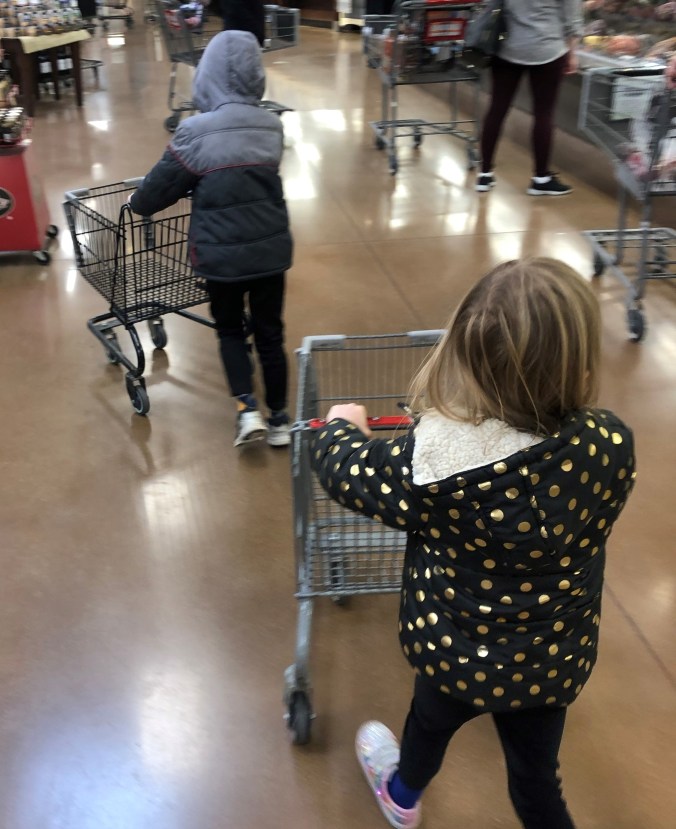 While grocery shopping on a Saturday, with two of my children, I quickly lost count of the number of impatient shoppers. I’m sure it wasn’t the best parenting move to allow both of them to have their own mini-shopping cart…in a semi-crowded supermarket…just before a Winter storm was about to hit. But they wanted to help and I encourage independence. We had only been shopping about 3 minutes before the sighs of irritated shoppers became painfully obvious. For example, when my daughter’s wheel went wonky and the woman picking out potato chips next to her gave me a look of “my goodness, get her out of my way.” I stared her down with the biggest smile – she still wasn’t happy – even though it took a mere 4 seconds to get the wheel back on track. We picked up the pace and moved on.
 jenholtvluwer